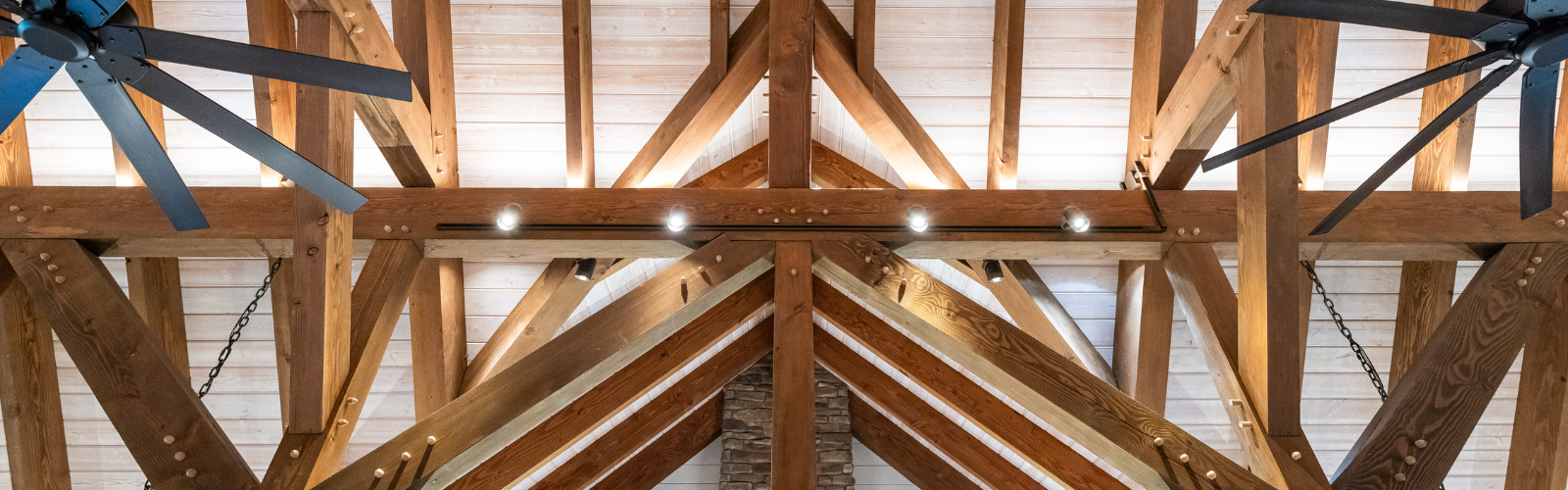
Heavy timber construction is widely admired for its warmth, craftsmanship, and strong architectural presence. But beyond aesthetics, designing a successful timber frame building requires a solid understanding of how it performs structurally. Timber behaves differently from steel or concrete, and its performance is shaped by a clear set of structural realities. Spans, connections, loads, and material behavior all influence what’s feasible, how the structure comes together, and how it performs over decades of use.
Below, we’ve outlined a few fundamentals that can help architects make informed, efficient decisions when designing with heavy timber.
Spans: Designing Within Timber’s Structural Limits
Span lengths in heavy timber construction are closely tied to member size and depth. As spans increase, timber beams typically need to grow thicker and wider at a faster rate than steel, which can significantly affect ceiling heights, floor thicknesses, and overall spatial proportions. Often in exposed-timber structures, concerns like deflection and vibration affect design before strength limits are reached, particularly in floor systems, where occupants can feel movement.
Because of this, early coordination with a structural engineer is essential. Aligning desired spans with realistic member sizes and acceptable deflection criteria helps avoid late-stage redesigns or visual compromises.
Connections: Structurally Critical & Visually Defining
Connections are among the most technically demanding elements of a heavy timber structure. They must transfer gravity and, in some cases, lateral loads. Additionally, the connections must accommodate wood movement and meet fire-resistance requirements — all while supporting the design intent. Traditional mortise-and-tenon joinery highlights craftsmanship and historic precedent, while concealed steel connections offer a more contemporary, streamlined appearance. Each of these common connection types affects fabrication complexity, cost, and sequencing differently.
Because connections strongly influence both visual character and constructability, they should be integrated early in the design process rather than treated as secondary elements.
Loads: Gravity, Lateral Forces & System Performance
Heavy timber systems perform exceptionally well under gravity loads, efficiently carrying weight through beams and columns while enabling open, flexible interior spaces. Lateral loads from wind and seismic forces, however, are often resolved most efficiently within the building enclosure system. The choice and placement of these systems will have a direct impact on architectural planning and aesthetics, so it’s important to consider them from the beginning.
Load Paths: Thinking Beyond Individual Members
Successful timber design depends on establishing clear load paths from roof to foundation. Ideally, these paths are continuous, with aligned columns, consistent framing grids, and minimized point loads to control member sizes and simplify connections. However, a direct load path isn’t essential, and instead, an indirect path with larger members and modified detailing to compensate may be utilized. Early system-level thinking allows architects to consider direct and indirect options and balance structural logic with spatial goals, controlling complexity and minimizing resultant cost increases.
Material Behavior: Movement & Durability
Wood is a living material that responds to moisture, temperature, and time. If not properly accounted for, shrinkage, differential movement, and exposure conditions can affect both structural performance and finishes. Accommodating movement through thoughtful detailing and coordination with enclosure systems is critical to ensuring long-term durability.
When these characteristics are properly understood and anticipated, heavy timber’s natural behavior becomes a manageable design consideration rather than a source of future issues.
Designing with Heavy Timber: A Holistic Approach
Designing with heavy timber works best when spans, connections, loads, and material behavior are considered together from the start. If you’re an architect exploring timber for your next project, Mid-Atlantic Timberframes is always open to early design-phase conversations. Contact us to test span assumptions, review connection strategies, or discuss any other questions you have about timber construction.